

PEPTIDE PEN-ANTI-C
12 May 2026
V.Med SELANK 7000 NASAL SPRAY
15 May 2026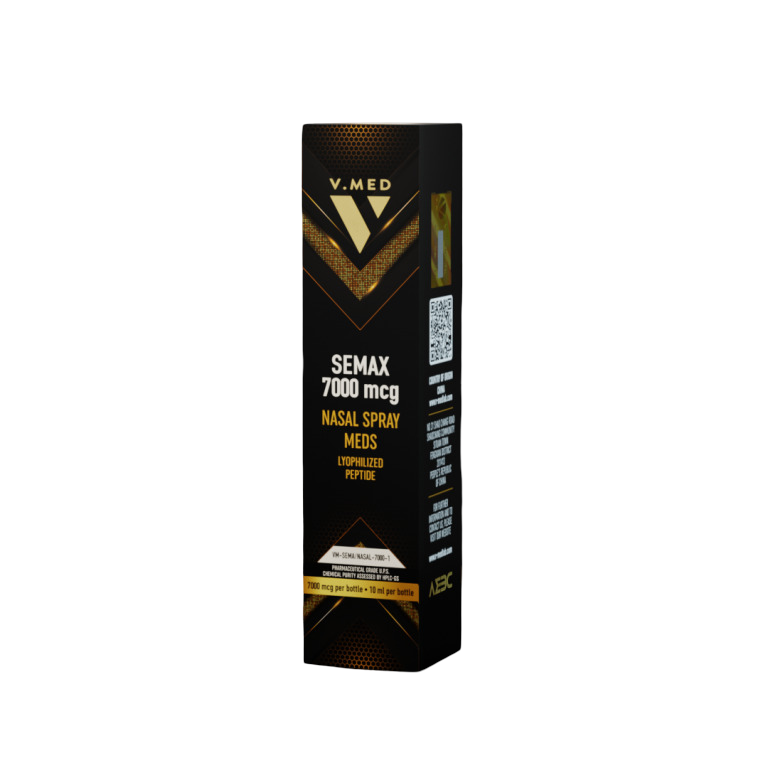
V.Med SEMAX 7000 NASAL SPRAY
R600.00
- SEMAX 7000 mcg 10 ml NASAL SPRAY
- 7000 mcg per bottle
- 10 ml Nasal Spray
Semax is a synthetic heptapeptide with the sequence Met-Glu-His-Phe-Pro-Gly-Pro and is derived from adrenocorticotropic hormone while lacking ACTH’s hormonal activity. It is commonly delivered intranasally, partly because peptide drugs generally face major oral delivery barriers such as enzymatic degradation, instability, and poor permeability in the gastrointestinal tract. In cognitive and recovery focused settings, Semax is mainly associated with attention, memory, and neuroprotective support rather than endocrine or anabolic effects.
Properties and Effects
Supports attention and short term memory
May support focus and mental clarity
May support neurotrophic signalling such as BDNF related pathways
May support neuroprotection during neurological stress conditions
Does not act as a steroid, testosterone agent, or growth hormone analogue
Mechanism of Action
Semax influences brain function through neurotrophic and monoaminergic pathways rather than through classic hormonal signalling. Preclinical and review data indicate that intranasal Semax can increase BDNF expression and affect related TrkB signalling, while other work suggests effects on monoamine systems and broader gene expression linked to immune and vascular responses in injured brain tissue. This supports a model in which Semax acts as a regulatory neuropeptide rather than a direct stimulant or hormone.
Recommended Use
Semax is typically used in cognitive support, focus, memory, or neurorecovery oriented protocols. Nasal delivery is the usual format in the published human and Russian clinical style literature. It is generally considered in settings where improved attention, mental performance, or neurological support is the goal, rather than muscle gain, hormonal enhancement, or aggressive stimulation.
Safety and Side Effects
Human safety evidence remains limited. The Alzheimer’s Drug Discovery Foundation review notes that little human evidence exists for side effects, and long term side effects are unknown. Reported adverse effects in reviewed human use include nasal cavity discolouration in about 10% of patients and increased blood glucose in diabetics in about 7.4% of patients, although the underlying source literature is limited. Semax is not described as suppressing testosterone or causing aromatisation because it is not an anabolic or endocrine acting compound.
Special Notes
Semax is not a steroid, SARM, SERM, testosterone product, or growth hormone. It is better classified as a neuroactive regulatory peptide and nootropic peptide. Its role is primarily cognitive and neuroprotective, with emphasis on attention, memory, and nervous system support rather than physique enhancement or hormonal manipulation.
Recommended dosage
The most defensible starting point is the bottle concentration itself. A 7000 mcg / 10 ml nasal spray contains 700 mcg per ml. If the pump delivers 0.1 ml per spray, that equals roughly 70 mcg per spray. Published human style data cited by the ADDF report includes intranasal use of 1 to 2 drops of a 0.1% solution twice daily in healthy individuals, while stroke protocols cited in that report used 2 to 4 drops of a 1% solution 3 to 4 times daily. A separate pilot study in healthy subjects used a total dose of 1.2 mg of intranasal 1% Semax. These are literature examples, not a universal dosing rule for every commercial spray.
Timing of doses
In the limited published and reviewed material, Semax is generally used during the day rather than as a bedtime product. The ADDF review cites twice daily use in healthy individuals and more frequent daytime administration in stroke settings, while one healthy volunteer study assessed brain network changes within minutes after a single intranasal dose. Exact timing rules are not well standardised across products.
Practical guidance
Semax nasal spray is better approached as a consistency based neuroregulatory product than as a stimulant. Actual dose per spray depends entirely on pump output, so spray calibration matters. Because it is a peptide in aqueous solution, careful storage, minimal heat exposure, minimal agitation, and good nozzle hygiene are sensible. Evidence for benefits exists, but the human literature is still limited and not strongly standardised by modern trial quality standards.