

V.Med TESAMORELIN 10
22 April 2026
PEPTIDE PEN-GLOW STACK
12 May 2026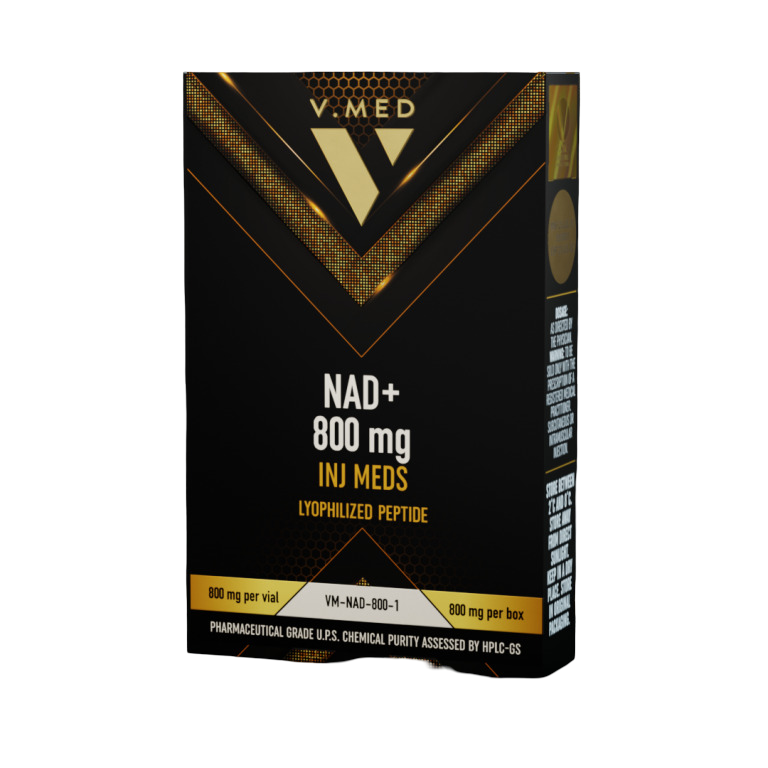
V.Med NAD+ 800
R680.00
- NAD+
- 800mg /vial
NAD+ is a coenzyme and nucleotide derivative, not a peptide, that is essential for cellular energy transfer and metabolic regulation. It participates in redox reactions and also serves as a substrate for enzymes involved in DNA repair, stress signalling, and cellular maintenance, including sirtuins and PARPs. It is commonly used in metabolic and recovery focused environments where mitochondrial support, energy balance, and cellular resilience are prioritised.
Properties and Effects
Supports cellular energy metabolism
Supports mitochondrial function and redox balance
May support recovery from metabolic stress
Supports DNA repair related signalling pathways
Does not act through hormonal or endocrine pathways
NAD+ functions as a core electron carrier in oxidation reduction reactions and is required for efficient cellular energy production. It also acts as a consumable substrate for enzymes such as sirtuins, PARPs, and CD38, which are involved in genome maintenance, stress responses, and metabolic regulation. Because of this dual role, NAD+ influences both energy turnover and cellular repair signalling rather than acting like a hormone or growth factor.
Recommended Use
NAD+ is typically used in metabolic, mitochondrial, cognitive, or recovery focused protocols. It may be considered during periods of high physical or mental stress, reduced energy, or increased recovery demand. It is generally used as part of a broader strategy that includes nutrition, hydration, sleep, and overall recovery practices.
Safety and Side Effects
Human evidence for direct NAD+ administration is still limited, but published reviews suggest the field is active and still developing. In one human pilot study, 750 mg intravenous NAD+ was administered over 6 hours without adverse effects being observed, while a newer real world comparison reported that NAD+ IV was associated with moderate to severe symptoms often requiring longer infusion times than NR IV. This suggests tolerability may depend strongly on route and administration speed. NAD+ does not suppress natural testosterone and is not associated with aromatisation because it is a cellular coenzyme rather than an anabolic hormone.
Special Notes
NAD+ is not a steroid, hormone, SARM, or SERM. It is better classified as a metabolic coenzyme or nucleotide derivative. Its role is supportive and regulatory at the cellular level, with emphasis on bioenergetics, repair signalling, and stress adaptation rather than direct muscle building or endocrine manipulation.
Recommended dosage
25 mg (very cautious start) – 6.25 units
50 mg – 12.5 units
100 mg – 25 units
150 mg – 37.5 units
200 mg – 50 units
Timing of doses
1 to 3 times per week
Practical guidance
NAD+ is generally approached more as a metabolic support compound than a conventional peptide cycle product. Administration protocols vary widely, so conservative use and careful monitoring are sensible. Where used parenterally, slower delivery is typically preferred, especially if tolerability is an issue. Long term outcome data for wellness style use remains limited, so it is better framed as an investigational or supportive compound rather than a guaranteed performance enhancer.
Estimated Degradation
Model classification
Moderate stability, possibly moderate to relatively stable when refrigerated, but clearly less stable once kept in aqueous solution over time.
Evidence strength
Moderate for general solution stability reasoning, weak for exact post reconstitution vial potency under real world handling conditions.
Assumption used
Reconstituted in sterile or bacteriostatic water, stored refrigerated at 2 to 8 degrees Celsius, protected from light, minimal agitation, and not held in alkaline or phosphate rich conditions. Supplier stability documentation states that neutral or slightly acidic NAD+ solutions are stable at 0 degrees Celsius for at least 2 weeks, while heating and alkaline conditions accelerate degradation. A recent stability study also examined NAD+ behaviour in common buffers over time at 19 degrees Celsius and 25 degrees Celsius, supporting the view that solution stability is condition dependent rather than fixed.
Estimated degradation model for NAD+ 800 mg
| Time after mixing | Estimated remaining potency | Estimated degradation |
| 1 week | 97% | 3% |
| 2 weeks | 93% | 7% |
| 3 weeks | 88% | 12% |
| 4 weeks | 82% | 18% |
| 5 weeks | 75% | 25% |
| 6 weeks | 67% | 33% |